
Why Round Rock Clay Soil Moves Foundations
The geology under Round Rock, why it cracks slabs, and the drainage and watering practices that help, based on Texas soil science and engineering guidelines.
Round Rock Ground on Each Side of I-35
I-35 follows the Balcones fault line through the city, and the ground changes across it.
Swipe the table sideways to see every option →
| Feature | East of I-35 | West of I-35 |
|---|---|---|
| Landscape | Flat Blackland Prairie | Hilly edge of the Hill Country |
| Bedrock | Upper Cretaceous shale, marl and chalk | Lower Cretaceous limestone and dolomite |
| Soil | Thick, dark calcareous clay | Thin soil, ledges and pockets of clay |
| Main foundation risk | Seasonal shrink and swell of deep clay | Fill on cut lots, clay pockets, slopes |
| Typical neighborhoods | Forest Creek, Teravista, Paloma Lake | Brushy Creek, Mayfield Ranch |
Soil varies lot by lot on both sides. The USDA Web Soil Survey shows the mapped soil under your address.
Round Rock Sits on a Fault Line
The city straddles the Balcones Escarpment, a zone of down-to-the-east faults, and I-35 was routed right along its edge. To the west, older limestone sits near the surface under thin soil. To the east, the rocks dropped and younger shales, marls and chalks are buried under thick, black prairie soil. That's why Round Rock homes a few miles apart can have completely different foundation stories.
What Makes Prairie Clay Move
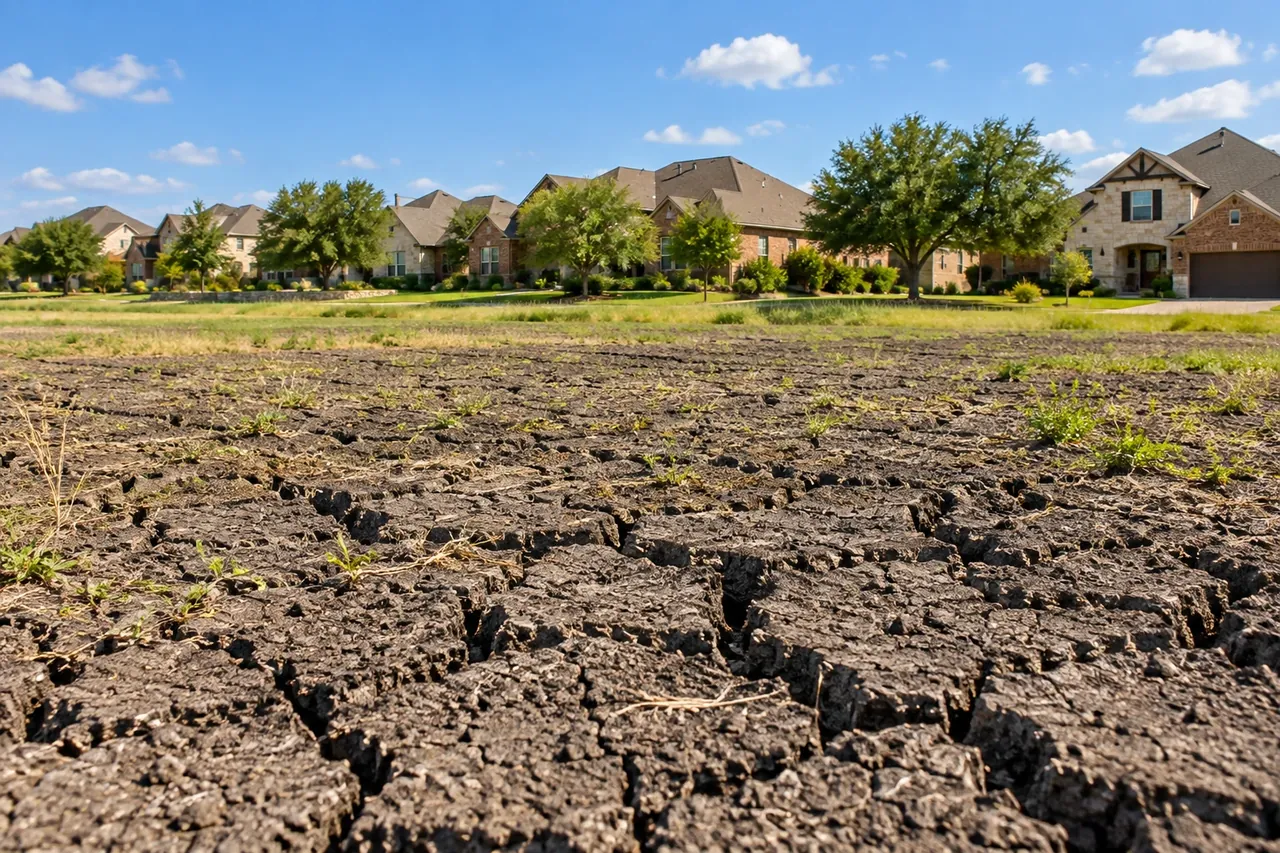
The signature soil of the Blackland Prairie is Houston Black clay, proposed as the Texas state soil and mapped across about 1.5 million acres from north of Dallas to San Antonio. Soil scientists classify it as a Vertisol: it shrinks and swells markedly as its moisture changes. When it dries it cracks open, and water then pours in fast; once it's moist, water barely moves through it. The Texas Water Development Board's soil fact sheet notes that its very high shrink-swell potential is a common limitation for building sites.
A UT Austin geoscientist summed it up for FOX 7 in December 2025: these clays expand when they get wet and shrink when they dry. He also noted that the worst spots are patchy rather than citywide, which matches what floor surveys show here.
The Weather Makes It Worse
Round Rock averages about 36.5 inches of rain a year, but it comes in bursts separated by long hot spells, with record highs near 109°F. A wet spring swells the clay; a dry August shrinks it, and the slab edge drops. In the dry summer of 2022 the city declared Stage 1 water restrictions, after the Brazos River Authority had issued a drought warning for Lake Georgetown, Round Rock's main water supply.
What the Engineering Guidelines Recommend
- Slope the ground away. At least 5 percent fall for the first 10 feet where practical.
- Extend downspouts well past the foundation, and keep them out of perforated drain pipe.
- Keep moisture steady. Engineers interviewed by FOX 7 stressed controlling water around the foundation; in drought, gentle foundation watering on allowed days helps.
- Be realistic about trees. The guidelines note that pruning trees may not bring a dropped foundation back up.
- Test before big repairs. For comprehensive repairs the guidelines recommend site-specific soil borings.
When the soil has already moved the house too far, the fix is piers or leveling, plus drainage correction so it doesn't happen again.
Frequently Asked Questions
What kind of soil is under Round Rock?
East of I-35 it's mostly deep, dark Blackland Prairie clay over chalk and marl. West of I-35 the soil is thinner over limestone, the edge of the Hill Country.
Why does clay soil crack foundations?
Expansive clay swells when wet and shrinks when dry. When one part of a slab sits on wetter or drier soil than another, the slab bends and cracks.
Are homes west of I-35 safe from foundation problems?
Not entirely. Thin soil over limestone moves less, but fill on leveled lots and pockets of clay can still cause settlement.
How can I find out my soil type?
The USDA Web Soil Survey maps soils by address. Our free evaluation also tells you how your house is responding to it.
Does watering my foundation really help?
In drought it can keep clay from shrinking away from the slab. Water gently and evenly a foot or two from the house, and follow Round Rock's current watering stage.
Worried About Your Soil? Get a Free Evaluation
Call now or request your free on-site foundation evaluation. No cost, no obligation.
- Free on-site evaluations
- City permit & engineer paperwork handled
- Pressed concrete & steel piers
- Cleanup & haul-away